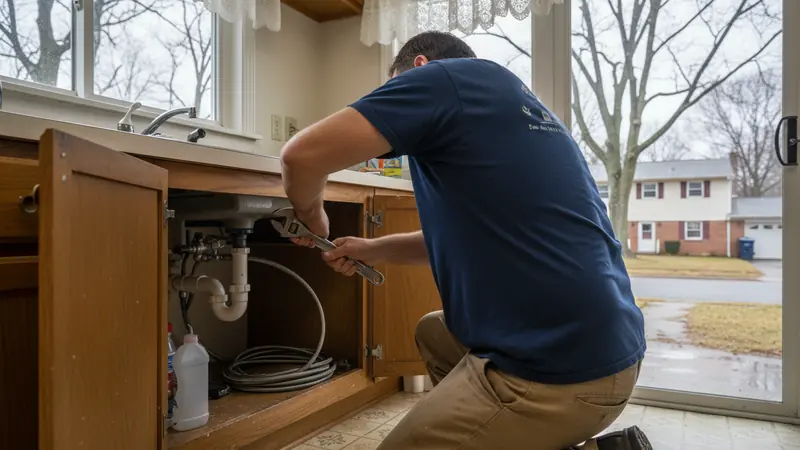
Well pumps, pressure tanks, water treatment and septic-connected drains: what you need to know about repairs in rural western Howard County.
We date every figure when we gather it. If a source is older or leaves a charge unclear, we say so.
Start with the system your house actually has
On the Howard County side of Woodbine, your home may use a private well and onsite sewage disposal. Howard County's Bureau of Utilities says its public water and sewer service serves the eastern county. It directs questions about private systems to the Health Department. A Woodbine mailing address alone does not tell you which services a property uses. Nor does it tell you who handles its permits.
If your house uses private systems, gather the well record, pump installation details, septic layout and approved disposal area. Howard County's Well & Septic Program links a Public File Search for those records. Look up your own property. A neighbour's well depth or septic layout will not tell you what you have.
Those records help you separate work inside the house from work at the well or in the garden. A bathroom drain is one part of the wastewater system. The pipe to the septic tank, the tank itself and the disposal field are separate parts. Getting your water pressure back does not tell you whether the water is safe to drink.
We could not find a primary-source housing-age breakdown for Howard County's Woodbine homes. We could not find a well-and-septic percentage for those homes either. Countywide housing totals would not tell us either fact about this rural area.
Source: Howard County Bureau of Utilities, Customer Service—Private Well and Septic Systems; Howard County Health Department, Well & Septic Program and Public File Search, undated webpages. Gathered 2026-09-22.
Do you actually need a permit?
Replacing a gas or electric water heater requires a plumbing permit. It also requires an inspection. DILP's published FAQ says a master plumber must get that permit. If your property uses a private well and septic, the same FAQ requires prior Health Department approval for the permit.
For water or sewer line repairs and replacements, the County says to get a plumbing permit first. You then need to arrange an inspection. The Health Department's Well & Septic Program also oversees well and septic installation and repair. Do not assume an interior plumbing approval lets you dig up or alter the disposal system.
Replacing a pressure tank alone is a different job from replacing a pump or drilling a new well. The documents we reviewed gave no clear, complete exemption list for these repairs. We could not verify a blanket “like-for-like well equipment is exempt” rule. Tell DILP which components and piping you are changing at 410-313-2455, option 4. Give the same details to the Well & Septic Program at 410-313-1771.
We could not settle this one. The County publishes separate plumbing and well/septic procedures. But the documents we reviewed do not settle every pump-only or tank-only replacement. Ask the County how it classifies your job. We cannot assume it carries a well-drilling fee. We cannot say it is permit-free either.
Source: Howard County DILP, Inspections, Licenses & Permits—FAQs and Licenses & Permits Division—Sewer/Water Repairs or Replacements; Health Department, Well & Septic Program, undated webpages. Gathered 2026-09-22.
What the permit costs
DILP's plumbing fee schedule was adopted under Council Resolution 83-2026, effective July 1, 2026. You pay these government charges separately from the contractor's work.
| DILP item | Published fee |
|---|---|
| Nonrefundable filing fee, other than Express | $50 |
| Express plumbing permit, up to 5 fixtures | $50, no separate filing fee |
| Residential minimum, including first fixture | $25 |
| Each additional residential fixture | $5 |
| Replacement water heater or sewer ejector | $25 each |
| Water/sanitary piping, first 200 feet, excluding piping 8 inches or larger | $100 |
| Each additional 100 feet or fraction | $25 |
| Water connection at right-of-way or building | $50 |
| Sewer connection at right-of-way or building | $50 |
| Technology surcharge | 10% |
There is no single pump-replacement total. The schedule does not name well pumps or pressure tanks. It does not clearly say whether the surcharge includes the filing fee either. We can only give the individual charges. DILP must classify your job. Ask it to confirm the total at 410-313-2455, option 4.
Source: Howard County DILP, FY27 Plumbing Permit Fee Schedule, Council Resolution 83-2026, effective 2026-07-01. Gathered 2026-09-22.
The Health Department publishes a different schedule:
| Environmental Health item | Published fee, surcharge included |
|---|---|
| Well permit, inspection and sampling | $160, marked state-law capped |
| Percolation-test application for failing system | $265 |
| Septic permit: new, upgrade or BRF installation | $496 |
| Failing septic-system repair permit | $265 |
| Septic tank replacement | $288 |
| Minor septic repair | $133 |
These figures come from the linked sheet dated July 2024. We have not independently verified them as FY27 charges. The sheet says the fees already include the technology surcharge. Do not add it again. It lists a percolation application separately from a repair permit. It does not say every repair needs both.
The fee sheet is older. The Environmental Health page still links to it. We could not establish a newer effective schedule. These are the County's published figures, not a guaranteed September 2026 bill. Ask Environmental Health which category applies at 410-313-6300. Confirm the current charge too.
Source: Howard County Bureau of Environmental Health, Schedule of Fees, marked 07-2024; no separate effective date stated. Gathered 2026-09-22.
How long approval and inspection actually take
We could not establish a reliable Woodbine plumbing-permit turnaround figure. We also found no published guaranteed approval period for pump and pressure-tank jobs.
The County makes a narrower commitment for septic repairs. Its repair/upgrade form says a sanitarian will contact you within three business days, depending on urgency. That contact is to arrange scheduling and review. It does not mean you will have a permit or a finished repair by then. Tell the County about planned additions or property changes when you request the repair. You cannot simply add them during the field visit.
Seasonal testing can also affect your timing. The program's posted notice says wet-season percolation testing closed March 27, 2026. Not every septic repair must wait for another wet season. But if your job needs that testing, an ordinary plumbing calendar cannot give you a completion date.
For DILP inspections, useful codes include:
- 720: rough-in; 705: final plumbing.
- 712: groundwork.
- 730: combined sewer/water repair or replacement.
- 731: sanitary sewer repair or replacement.
- 732: water-service repair or replacement.
You can request an inspection through the automated number, 410-313-3800. Published scheduling lets you request the next day or up to seven working days ahead. For an emergency water/sewer inspection, call 410-313-1840 before 9 a.m. Requesting one does not guarantee an inspector will attend. The listed plumbing codes do not replace Health Department well/septic inspections.
Source: Howard County Health Department, Septic System Repair/Upgrade Information Form, dated 02-2020, and Well & Septic Program—Wet Season Testing 2026; DILP, Automated Inspection Request and Permit Information System, April 2025 posting with December 2024 instructions. Gathered 2026-09-22.
What the well installation inspector checks
Howard County's pump, pitless-adapter and supply-piping form records both pump capacity and well yield. They measure different things. You need to know about the water source as well as the pump to choose equipment.
The form asks the inspector to check these points:
- The well cap must be watertight. It must be secured too. The electrical conduit must be properly attached.
- Supply piping must sit at least 36 inches below grade.
- Pipe must have a pressure rating of at least 160 psi. That is a material rating. It does not tell you to run household plumbing at that pressure.
- A sleeve must extend at least 5 feet from the foundation at the house connection.
- Water-supply piping must sit at least 10 feet from the listed septic components and sewage reserve area. You need prior office approval to put it closer.
The installer must request the Health Department inspection before 9 a.m. on the day they want it. They must leave the work uncovered until it is approved.
The form still cites an old code. It refers to the National Standard Plumbing Code, including a 1990 provision. The dimensions above come from the County form's checklist. We have not established that its old code edition governs new work. Check which requirements apply with Well & Septic at 410-313-1771, particularly before you dig near the disposal area.
Source: Howard County Health Department, Information Form for Installation of the Well Pump, Pitless Adapter, and Supply Piping, undated form. Gathered 2026-09-22.
- 1A watertight, secured well cap with the electrical conduit properly attached.
- 2Supply piping at least 36 inches below grade, which is what puts the connection below the frost line.
- 3Pipe rated to at least 160 psi — a material rating, not an instruction to run household plumbing at that pressure — and a sleeve extending at least 5 feet from the foundation at the house connection.
- 4Water-supply piping at least 10 feet from the septic tank, the pump chamber, the sewage piping, the distribution box, the drain fields and the reserve area. A closer arrangement needs prior office approval.
Howard County Bureau of Environmental Health well construction requirements; COMAR 26.04.04. Read 23 September 2026.
Who is allowed to do the work, and which code applies?
Maryland's Board of Plumbing licenses plumbers working in Howard County. You can search its public licence records by name or licence number. Match the responsible licence holder to the person on your permit paperwork. A company name alone does not tell you whether an individual is licensed.
The county's current plumbing standard is the 2024 International Plumbing Code with Howard County amendments, effective September 7, 2025. The adopted bill requires exterior water-supply piping to sit at least 36 inches below grade. The county's well program separately points to Maryland's well-construction regulations, COMAR 26.04.04.
Homeowner applications have limits. Under the March 9, 2026 form, you must own the home. You must live there too. You must do the work yourself. The form excludes exterior work and gas work. It also excludes connections between your home and public or private water or disposal systems. It lists $50 plus $5 technology fee, $55 total.
The homeowner paperwork and statute use different language. The adopted code describes qualifying work you do yourself as permit-exempt. It requires you to give written notice. You must also allow an inspection. The current form calls this a homeowner permit. It charges a fee. We used the form to establish how the County handles applications. We could not resolve the legal difference. You can check with DILP at 410-313-2455, option 4. Neither document says you may make the final private-system connection yourself.
Source: Maryland Department of Labor, Board of Plumbing and Plumbers Public Query, query updated 2026-05-28; Howard County DILP, Adopted Codes, effective 2025-09-07, Council Bill 26-2025, and Homeowner Request for Plumbing Work, dated 2026-03-09; Health Department, Well & Septic Program regulations index. Gathered 2026-09-22.
What goes wrong with the water supply here
Find out why your pressure is low before you order equipment. Maryland's pump-installer study outline covers pressure-switch operation, pump testing, electrical supply, leaks, pumping water levels, recovery and over-pumping. You can use those topics to ask for a written diagnosis. They do not mean every weak shower points to a failing pump.
When you get a Woodbine well-system quote, ask what was measured. What was the pressure when the pump started and stopped? What flow did it deliver? What points to a pump, control, pressure-tank or source-water problem? Ask for the pressure tank to be checked too. Do not assume it will survive every pump replacement. These are suggested checks. We are not claiming any of these problems is the most common local failure.
We found no county-specific failure-rate data, standard household pressure setting, pump lifespan or pressure-tank replacement interval. Base your repair on the equipment you have and how your well actually performs.
Source: Maryland Department of the Environment, Apprentice Pump Installer & Pump Installer License Study Topics, undated. Diagnostic questions are an inference from its listed competencies. Gathered 2026-09-22.
Water quality needs its own evidence. Howard County recommends testing your private well annually. Test after well repairs too. Test if the appearance or taste changes. Get tests before you choose treatment. It names coliform bacteria and nitrate as useful initial indicators. Nitrate can reach groundwater from fertiliser, septic systems and animal waste.
The County says it can generally collect established-well samples for bacteria and nitrate without a collection charge. The state laboratory may still charge to analyse them. We could not establish the exact current laboratory fee. You can get help with testing at 410-313-1773.
Even if your flow rate is back to normal, the County still recommends testing after repairs. Before you buy a softener, follow the County's advice to establish the water problem first. Choose treatment once you know what needs treating.
Source: Howard County Health Department, Well Water Testing, undated webpage. Gathered 2026-09-22.
Local geology can matter too. The Health Department's radionuclide guide reports elevated natural radioactivity in some wells in and around the Baltimore Gneiss formation. Through calendar 2019, approximately 19% of tested wells in that formation and its vicinity in Howard County exceeded the recommended gross-alpha standard.
That is not a Woodbine-wide contamination rate. It describes tested wells in a particular geological setting. They were not a random sample of all local homes. The guide reports no observable link between elevated results and well depth, yield or age. A deep or productive well does not rule this problem out. Discuss suitable testing with Environmental Health using your property location and testing history.
Source: Howard County Health Department, Radionuclides and Your Well Water: A Homeowner's Guide, cover revised November 2018, body incorporating results through 2019, file posted February 2020. Gathered 2026-09-22.
Septic-connected drains and treatment backwash
Howard County lists slow drains, sewage smells near the tank or drainfield, and sewage surfacing outdoors as warning signs. Its factsheet names waterlogged soil, excessive water loading, solids or grease and invading roots as possible causes. The County describes these problems without ranking how often they happen in Woodbine.
The County recommends having your tank inspected at least every three years. Have it pumped on that schedule too. A BAT nitrogen-reduction unit needs at least annual service. Your provider must be certified by both Maryland's environmental department and the manufacturer.
Treatment equipment affects where the water drains. The factsheet says water-treatment backwash should bypass the BAT unit. It should go to the sewage disposal system. That connection needs a Health Department septic permit. The factsheet does not give you permission to discharge it onto the garden instead.
Ask your treatment installer to include where the backwash will go in the quote. A quote that only describes the new equipment leaves that part of the job unanswered.
Source: Howard County Health Department, Fact Sheet—Onsite Sewage Disposal Systems, posted March 2026; document retains footer date 2017-02-15, so a complete revision date is unclear. Gathered 2026-09-22.
A new bathroom can become a septic-capacity question
If your home uses private systems, adding a bathroom takes more thought than whether the drain reaches the existing pipe.
The Health Department's March 25, 2026 floor-plan memorandum says it checks bedroom counts in new dwellings and living-space additions. A room can count even if your drawings call it something else. It can also count without meeting DILP's bedroom definition.
The memorandum quotes a septic-code definition that includes conditioned space of 90 square feet or more. To qualify, that space must be usable for private sleeping. It must have a window. It must also have an interior door. The memorandum also describes exceptions for offices, libraries and similar rooms, with conditions. Leaving out a closet does not meet the whole exception.
In a basement project, rough plumbing for a future full bathroom can affect that exception. Get your actual floor plan reviewed before assuming an office or guest area will not affect septic approval. Not every bathroom requires a replacement septic system. But you do need to settle the approved bedroom count for your proposed layout.
Source: Howard County Health Department, House Floor Plans memorandum, dated 2026-03-25, quoting Howard County Code §3.801(b). Gathered 2026-09-22.
What the work is worth
We could not find primary-source installed prices specific to Woodbine or Howard County for a well-pump replacement or pressure tank. We found none for treatment installation or septic-connected drain repair either. We cannot give you a sourced local price range.
Compare what each contractor puts in writing. Look for the diagnosis, equipment and piping. Check what digging they include. Ask how they will put the ground back. Settle who handles permits. Ask who arranges inspections. Check what sampling they include after the repair. For treatment work, ask where the backwash will go. For septic repairs, ask which component they will repair. We drew these questions from the county procedures above. They are not a government pricing formula.
A low quote for replacing a part may cover different work from a higher quote for finding and fixing the problem. We can identify government permit charges. Your installed total depends on your property. We found no source for that total.
Source: Scope comparison inferred from Howard County Health Department's well installation form, Well Water Testing and septic repair form, dated or undated as identified above. No local installed-price dataset established. Gathered 2026-09-22.